
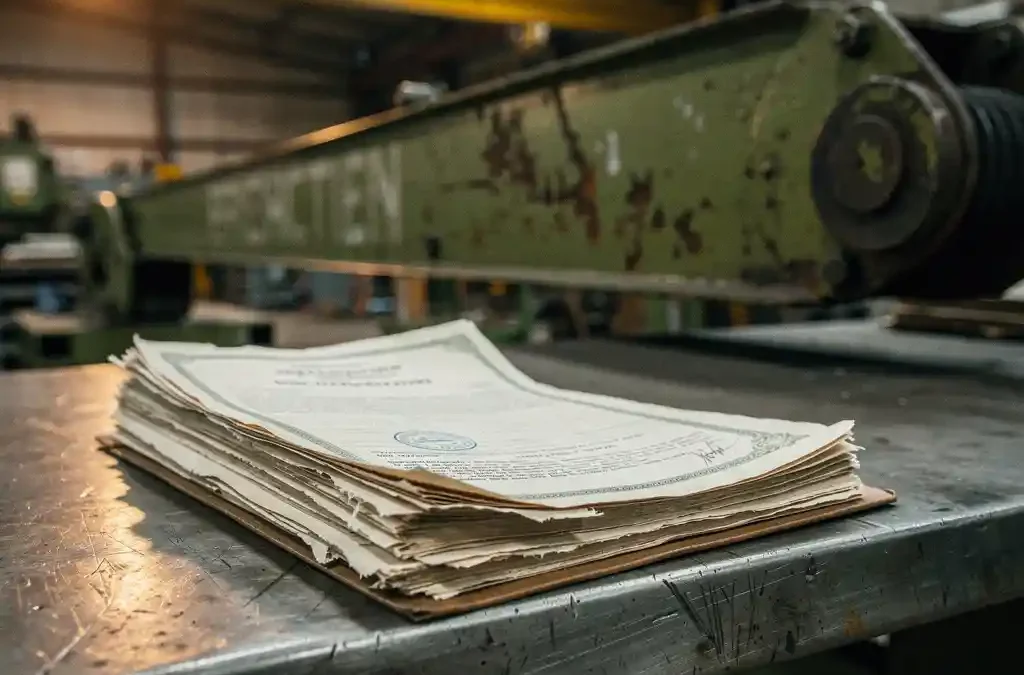
If your crane has recently come back from a boom repair, the paperwork that follows matters more than most operators realize. Regulators, insurers, and clients can all ask to see your crane repair documentation at any point, and gaps in that record can create serious problems. Knowing exactly which crane boom repair records to keep, and for how long, protects your business and keeps your equipment legally operational.
The rules around crane repair documentation are not always spelled out in one tidy place. They come from a mix of European machinery directives, national legislation, and industry standards, which makes it easy to miss something. This guide pulls it all together so you know where you stand.
Legal and industry requirements for crane repair records
In the Netherlands and across most of Europe, cranes fall under the Machinery Directive (2006/42/EC) and the Work Equipment Directive (2009/104/EC). Both require employers to maintain documentation that demonstrates a crane is safe to operate. When a structural repair is carried out on a boom, that repair becomes part of the crane’s technical history and must be traceable.
Beyond European directives, industry standards such as EN 13000 (for mobile cranes) and ISO 9927 (for crane inspections) set expectations for what gets documented and when. If your crane operates in the offshore sector, additional requirements from bodies such as DNV or Lloyd’s Register may also apply. The short answer is: if the repair touched the structure, it needs a paper trail.
Which documents must be kept after a boom repair
A thorough crane maintenance record after a boom repair is not just one document. It is a collection of files that together tell the full story of what was done, by whom, and to what standard. Missing even one of these can leave a gap that becomes difficult to explain later.
- Repair plan and Welding Procedure Specification (WPS) — the technical blueprint used during the repair, confirming the correct procedures were followed for the grade of steel involved
- Material certificates — proof that any steel or consumables used in the repair meet the required specifications
- Inspection reports — including visual inspection findings, Magnetic Particle Inspection (MPI) results, and any ultrasonic or X-ray test reports from a third-party Notified Body
- Photographs of the repair — a visual record of the damage before, during, and after the repair process
- CE declaration of conformity — confirming that CE certification remains valid following the repair
- Welder qualifications and certifications — evidence that the personnel who carried out the welding were qualified to work on high-grade steel
- Guarantee documentation — any written guarantee issued by the repair company covering the work performed
If a third-party inspector was involved, their report should be stored alongside the other documents rather than filed separately. Keeping everything in one place for each repair event saves significant time during audits.
How long each record type should be retained
Retention periods vary depending on the type of document and the regulatory framework that applies. As a general rule, structural repair documentation should be kept for the full working life of the crane, plus an additional period after it is decommissioned.
- Welding procedure specifications and repair plans — retain for the lifetime of the crane. These documents are the technical foundation of the repair and may be needed if the crane is ever sold, re-certified, or involved in an incident.
- Inspection and NDT reports (MPI, ultrasonic, X-ray) — a minimum of ten years is a widely applied standard, though some insurers and clients require longer. Check your specific contractual obligations.
- CE documentation — keep for the lifetime of the machine. The CE declaration is tied to the crane itself and must travel with it.
- Welder qualifications — these are typically valid for two years and must be renewed, but copies of qualifications relevant to a specific repair should be retained alongside that repair’s records for at least ten years.
- Guarantee certificates — at minimum for the duration of the guarantee period, but practically speaking, these should be kept much longer as evidence of the standard of work performed.
When in doubt, keep it longer. Storage costs are negligible compared to the cost of being unable to demonstrate compliance when it counts.
Consequences of incomplete or missing repair records
Incomplete crane inspection records create risk on multiple fronts simultaneously. The most immediate consequence is operational: if a crane cannot be verified as safe through its documentation, it may be taken out of service until the records are reconstructed or the repair is re-inspected, which takes time and money.
From a legal standpoint, missing records can result in fines or enforcement action from occupational health and safety authorities. If a crane is involved in an incident and the repair documentation is incomplete, liability exposure increases significantly. Insurers may also use gaps in documentation as grounds to reduce or reject a claim.
There is also a commercial dimension. Many clients and project owners now require access to a crane’s full maintenance and repair history before allowing it on site. A crane with incomplete records can simply be turned away, costing the operator the contract entirely.
Best practices for managing crane repair documentation
Good documentation habits do not require a complicated system. What they do require is consistency. Establishing a clear process from the moment a repair is commissioned means nothing gets lost between the workshop and the filing cabinet.
Centralise records by asset
Each crane in your fleet should have its own dedicated file, whether physical or digital. Every repair event, inspection report, and certificate goes into that file immediately after it is received. Searching across multiple systems or folders when an auditor arrives wastes time and increases the risk of something being missed.
Request the full documentation package from your repair provider
A reputable crane boom repair specialist will provide a complete documentation package as standard. If you are not receiving a WPS, MPI results, photographs, and a CE declaration after every structural repair, ask for them explicitly. You are entitled to this documentation, and it is part of what you are paying for.
Set calendar reminders for retention deadlines
It sounds simple, but many businesses only discover a document has been deleted or discarded when they need it. Setting reminders tied to the crane’s service history helps ensure nothing is removed prematurely.
Back up digital records securely
If you store records digitally, make sure backups exist in at least two locations. A server failure or a ransomware attack should not be able to wipe out ten years of crane maintenance records. Cloud storage with access controls is a practical and affordable solution for most fleet operators.
How Rusch Cranes helps with crane repair documentation
We understand that the paperwork side of a boom repair can feel like an afterthought, but we treat it as an integral part of the job. Every repair we carry out comes with a complete documentation package, so you always have what you need to demonstrate compliance.
- A full Welding Procedure Specification and Repair Plan prepared before work begins
- 100% visual inspection and MPI results on all new welds upon completion
- Third-party Notified Body reports where ultrasonic or X-ray testing is required
- Photographic records of every repair stage
- A valid CE declaration confirming certification remains intact after the repair
- A one-year written guarantee on all work performed
We carry out boom repairs worldwide, covering both telescopic and lattice booms in high-grade steel up to 1100 N/mm². Whether your crane is at a construction site, a port, or an international project location, we can deploy our team to you. If you want to talk through a repair or find out more about what documentation you should expect to receive, get in touch with us and we will walk you through it.
Frequently Asked Questions
What should I do if I've lost or never received some of the documentation from a past boom repair?
Start by contacting the repair company that carried out the work — reputable specialists retain copies of WPS documents, inspection reports, and CE declarations and may be able to reissue them. If the original provider is no longer reachable, commissioning a fresh third-party inspection and NDT assessment (MPI or ultrasonic) can help reconstruct a verifiable record of the current condition of the repair. Going forward, make it standard practice to request and file the full documentation package at the point of job completion, before the repair team leaves site.
Does a boom repair affect the original CE marking of my crane, and how do I make sure it stays valid?
Yes, a structural repair to a crane boom can affect the validity of the original CE marking, particularly if the repair alters load-bearing geometry or uses different materials than those specified in the original design documentation. To maintain CE compliance, the repair must be carried out according to a documented Welding Procedure Specification and subsequently verified by a Notified Body where required. Your repair provider should issue an updated CE declaration of conformity as part of the standard documentation package — if they do not, request one explicitly before the crane returns to service.
Are there any differences in documentation requirements if my crane operates across multiple countries?
Within the EU, the core requirements under the Machinery Directive and Work Equipment Directive apply consistently, so documentation prepared to those standards is generally recognised across member states. However, if your crane operates in the offshore sector or under jurisdiction-specific frameworks (such as those governed by DNV, Lloyd’s Register, or national labour inspectorates), additional certification layers may be required on top of the standard package. Always check the specific contractual and regulatory requirements of each project or territory before mobilising, and carry the full documentation file with the crane rather than leaving it in a central office.
How do I know whether a repair provider is qualified to work on high-grade steel crane booms?
Ask for evidence of welder qualifications specific to the grade of steel used in your boom — modern crane booms are commonly fabricated from high-strength steels up to 1100 N/mm², which require certified welding procedures and appropriately qualified personnel. A credible repair specialist will also hold relevant ISO certifications (such as ISO 3834 for welding quality) and will be able to name the Notified Body they work with for third-party inspection. If a provider cannot supply these credentials upfront, that is a strong signal to look elsewhere, regardless of price.
Can I store all my crane repair documentation digitally, or are physical copies legally required?
In most European jurisdictions, digital records are legally acceptable provided they are stored in a format that cannot be easily altered and can be produced on demand during an inspection or audit. Scanned PDFs of signed inspection reports, CE declarations, and welder qualifications are widely accepted, but check whether any specific contracts or insurers require original wet signatures on certain documents. As a practical safeguard, maintain at least two digital backup locations and consider retaining physical originals for the most critical documents, such as the CE declaration and the repair plan, for the lifetime of the crane.
What is the difference between a routine crane inspection report and the documentation required after a structural boom repair?
A routine inspection report (as required under ISO 9927 or equivalent national standards) covers the general condition of the crane at a point in time and is typically produced by a competent inspector on a periodic basis. Post-repair documentation goes further: it must demonstrate not only the current condition but also the process used to restore the structure — including the WPS, material certificates, NDT results, and welder qualifications. Think of routine inspection records as ongoing health checks, and post-repair documentation as the surgical notes that explain what was done and to what standard.
How should I handle documentation if my crane is sold or transferred to another operator?
The complete repair and maintenance history should transfer with the crane at the point of sale — this is not just good practice but a legal expectation under the Machinery Directive, which requires technical documentation to remain traceable throughout the machine’s working life. Organise all records by repair event in a single asset file and hand this over as part of the sale agreement, confirming receipt in writing. A crane sold with a complete, well-organised documentation history is also a more attractive commercial asset and can command a stronger resale value.
Related Articles
- Is there a difference between the crane manufacturer repairing a boom and an independent company doing it?
- Does it matter what filler wire is used when welding high-strength crane boom steel?
- What welding standards apply to crane boom repair in Europe?
- What is the lead time for a new telescopic boom section from a crane manufacturer?
- Is it cheaper to repair a lattice boom or replace it?
Recent Comments