
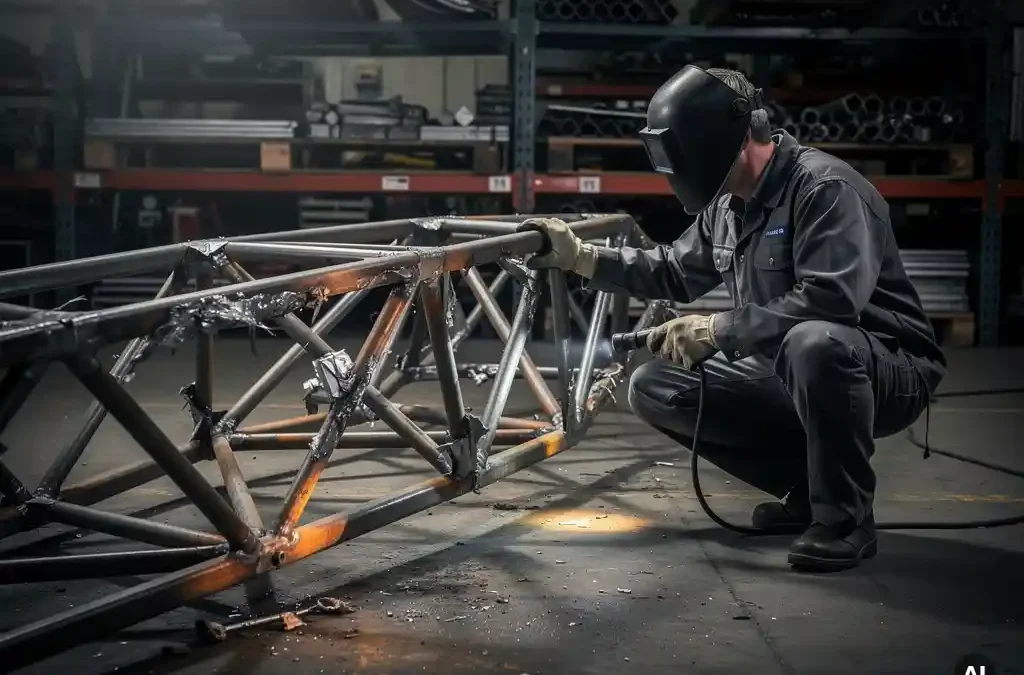
Yes, lattice booms can often be repaired after a tip-over, and in many cases, repair is the smarter choice over full replacement. Whether a repair is feasible depends on the extent and location of the structural damage, but even severely bent or cracked lattice sections can frequently be restored to their original load-bearing capacity by specialists with the right equipment and certifications.
The key is acting quickly and methodically. A thorough inspection must come first, followed by a structured repair process that meets the same engineering standards as the original manufacture. The sections below walk through what happens to a lattice boom in a tip-over, how damage is assessed, what repair involves, and what it means for certification and cost.
What types of damage does a tip-over cause to a lattice boom?
A tip-over subjects a lattice boom to sudden, uncontrolled impact forces that it was never designed to absorb. The resulting crane boom damage typically falls into several categories: bent or buckled chord members, cracked or fractured welds at node points, deformed lacing tubes, and in severe cases, complete section collapse. The damage pattern depends on how the crane fell, the ground surface, and which part of the boom absorbed the initial impact.
Lattice booms are constructed from interconnected steel tubes welded at precise angles. This geometry gives them exceptional strength under rated loads, but it also means that impact energy travels through the structure in complex ways. A single point of impact can cause visible deformation at the strike zone while also introducing stress fractures in sections that look undamaged on the surface. That is why visual inspection alone is never sufficient after a tip-over.
Common damage types include:
- Bent or kinked chord members along the main longitudinal tubes
- Cracked or broken welds at tube-to-tube connection points
- Buckled lacing members between the chords
- Deformed pin holes or connection flanges at boom section joints
- Surface gouging or abrasion that may mask deeper cracks
Can a lattice boom be repaired or does it need to be replaced?
In most cases, a damaged lattice boom can be repaired rather than replaced, provided the core structural members are not beyond restoration and the steel grade is compatible with certified welding procedures. Repair is viable when chord members can be straightened or replaced in sections, and when the surrounding structure retains its geometric integrity. Full replacement becomes necessary only when damage is so extensive that restoring the original geometry and strength is not achievable.
The distinction matters enormously from a cost and lead-time perspective. New lattice boom sections sourced from OEM manufacturers involve long procurement cycles and very high costs. A specialist repair, carried out under controlled conditions with the correct Welding Procedure Specifications, can restore the boom to a value equal to the original, at a fraction of the price and in significantly less time.
It is worth noting that lattice booms made from high-grade steels, including steels up to 1100 N/mm², require specialized welding knowledge that most general fabricators do not possess. The repair must be performed by a company with certified procedures for these materials, or the structural integrity of the repair cannot be guaranteed.
How is a lattice boom inspected after a tip-over?
Inspection after a tip-over follows a structured process that combines visual examination with non-destructive testing (NDT). A visual survey identifies obvious deformation, cracking, and surface damage. This is followed by Magnetic Particle Inspection (MPI), which detects surface and near-surface cracks that are invisible to the naked eye. Where deeper internal defects are suspected, ultrasonic testing or X-ray examination may be used to assess the full extent of the damage.
Before any measurements or testing begin, the boom is cleaned and prepared so that surface contamination does not obscure cracks or distort readings. Precise dimensional checks are then taken across all boom sections to identify any geometric distortion. Even small deviations from the original geometry can affect load distribution under working conditions.
The inspection also covers:
- Material strength verification, confirming the steel grade is consistent with the original specification
- Weld integrity checks at all node points and connection zones
- Pin bore and flange alignment assessment at section joints
- Full photographic documentation of every damaged area before any work begins
This documentation forms the basis of the Repair Plan and provides a clear record for certification purposes after the work is complete.
What does the repair process for a lattice boom involve?
Lattice boom repair begins with a Welding Procedure Specification (WPS) and a formal Repair Plan prepared before any welding takes place. These documents define exactly how each damaged section will be addressed, which consumables will be used, what pre-heat and inter-pass temperatures are required, and how the finished welds will be tested. This level of preparation is essential when working with high-strength steels, where incorrect welding parameters can introduce brittleness or residual stress.
The physical repair work involves cutting out damaged sections, straightening or replacing deformed members, and welding in new material that matches the original specification. Precision is critical throughout: the boom must return to its original geometry within tight tolerances. Workshop conditions are carefully controlled, and all new welds receive 100% visual inspection and 100% MPI upon completion. Where required, a third-party Notified Body conducts additional ultrasonic or X-ray testing before the boom is cleared for return to service.
Repairs can be carried out at a specialist workshop or, where logistics make it more practical, at the client’s location. For lattice boom repair projects, the most economical solution depends on the severity of the damage, the crane’s location, and the urgency of the return-to-service timeline.
Does a repaired lattice boom still meet CE certification requirements?
Yes, when a lattice boom is repaired by a qualified specialist following certified procedures, the CE testing of the crane remains valid after the repair is complete. This is not automatic, however. The repair must be carried out in accordance with the relevant standards, documented correctly, and verified through the appropriate inspection and testing regime. A repair that lacks this documentation trail cannot support continued CE compliance.
For operations managers and HSE officers, this is a critical point. A boom that has been repaired without certified procedures or proper documentation creates a compliance gap that exposes the operator to legal and financial risk. Choosing a repair partner with the necessary certifications and a formal quality system is not optional: it is a prerequisite for maintaining the crane’s operational status.
After a correctly performed repair, a guarantee covering the work provides additional assurance that the restored boom meets the same performance standard as the original.
How much does repairing a lattice boom cost compared to buying new?
Repairing a lattice boom typically costs significantly less than sourcing a replacement from the original manufacturer, and the time saving is often just as important as the financial one. New boom sections involve OEM procurement lead times that can stretch to many months, during which the crane remains out of service. A specialist repair, depending on complexity, can frequently be completed in a fraction of that time.
The exact cost difference depends on the extent of the damage, the steel grade, and the logistics of getting the boom to the repair facility or the repair team to the site. However, industry experience consistently shows that even complex lattice boom repairs deliver substantial savings compared to new-part replacement, making repair the preferred route for most operators when it is technically feasible.
Beyond the direct cost comparison, there is also the wider financial impact of downtime to consider. Every day a crane is out of service represents lost revenue, delayed project milestones, and potential contractual penalties. A faster repair route directly reduces that exposure.
How Rusch Cranes helps after a lattice boom tip-over
Rusch Cranes is one of just three companies in Europe capable of repairing booms made from 960 and 1100 grade high-strength steel, covering both telescopic and lattice configurations. After a tip-over, Rusch provides end-to-end support, from initial assessment through to certified repair and return to service. Key aspects of the service include:
- Full inspection using visual, MPI, and advanced NDT methods with complete photographic documentation
- Certified Welding Procedure Specifications and formal Repair Plans prepared before work begins
- 100% MPI on all new welds, with third-party Notified Body involvement where required
- Repair carried out at the client’s location anywhere in the world, or at the Rusch workshop in the Netherlands
- CE testing validity maintained after repair, with a 1-year guarantee on all work performed
If your lattice boom has been damaged in a tip-over or any other incident, the fastest path back to safe, certified operation starts with an expert assessment. Contact Rusch Cranes to discuss your situation and find out what repair options are available for your crane.
Related Articles
- How do I work out whether to repair a crane boom or buy a new one?
- How long does crane boom repair usually take and how does that affect my project?
- At what age does it stop making financial sense to repair a crane boom?
- How quickly does a cracked crane boom become a safety risk?
- What is the difference between a telescopic boom and a lattice boom repair?
Recent Comments