
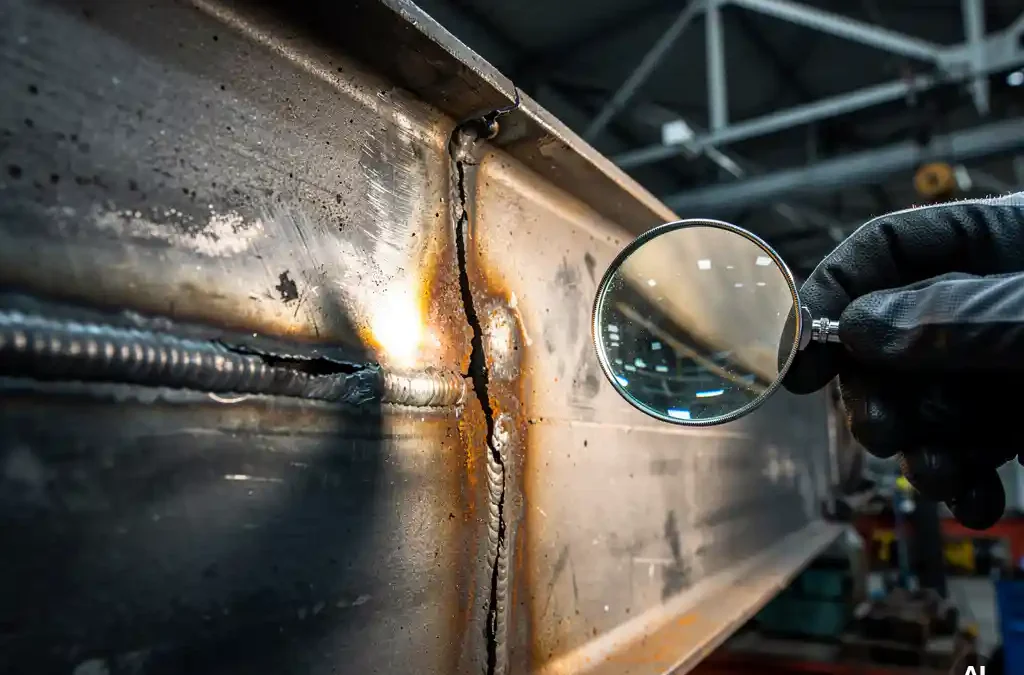
Crane boom weld defects that require immediate rework are those that compromise structural integrity under load: cracks of any length, lack of fusion, significant undercut in high-stress zones, and porosity clusters that exceed the tolerances defined in the applicable welding standard. These defects are not cosmetic: left unaddressed, they create stress concentration points that can propagate into full fractures, especially in high-grade steel booms operating under dynamic loads. The sections below answer the most important questions surrounding weld defect severity, detection, and repair decision-making.
What makes a weld defect critical versus acceptable in a crane boom?
A weld defect is critical when it reduces the load-bearing capacity of the boom or creates a site where fatigue cracking can initiate and grow. Acceptability is determined by the applicable welding standard, typically ISO 5817 or EN 1090, which defines tolerance limits for each defect type based on weld class, material thickness, and the stress level of the joint. Defects within those limits are considered acceptable; those that exceed them require rework.
The location of the defect matters enormously. A minor surface pore in a low-stress secondary weld is treated very differently from the same pore at the root of a primary chord weld on a telescopic boom. Crane booms are designed with specific load paths, and welds in high-tension zones carry far greater consequences when compromised. The weld class assigned to each joint during the design phase determines the acceptance criteria that apply, which is why a qualified inspector with knowledge of crane boom engineering must evaluate every finding in its structural context.
Which weld defects always require immediate rework?
Certain crane boom weld defects are never acceptable regardless of size, location, or weld class. These include cracks, lack of fusion, incomplete penetration in full-penetration welds, and cold laps. Any of these defects must trigger immediate rework before the crane returns to service.
- Cracks: Any crack (surface, subsurface, or crater crack) is a zero-tolerance defect. Cracks propagate under cyclic loading and will grow.
- Lack of fusion: Where the weld metal has not bonded to the parent material or previous weld pass, the joint has no structural continuity at that point.
- Incomplete root penetration: In joints designed for full penetration, a gap at the root creates a built-in notch that concentrates stress.
- Cold laps: Overlap of weld metal that has not fused with the base material acts as a delamination point under load.
- Significant undercut in primary welds: Deep undercut along the weld toe reduces the effective throat of the weld and introduces a sharp notch into the heat-affected zone.
Porosity, slag inclusions, and surface irregularities are evaluated against standard tolerances, but when they appear in clusters or exceed defined limits in high-stress areas of a crane boom, they also require rework without delay.
How does steel grade affect the severity of a weld defect?
Higher-grade steels are significantly more sensitive to weld defects than standard structural steels, meaning the same defect that would be marginal in S355 steel can be genuinely dangerous in S690, S960, or S1100 high-strength steel. This is because high-strength steels have lower ductility and fracture toughness relative to their yield strength, which means they tolerate stress concentrations less well.
Mobile crane booms are increasingly manufactured from steels in the 960 to 1100 N/mm² range to achieve the strength-to-weight ratios required for modern high-capacity cranes. Welding these materials demands tightly controlled heat input, preheat temperatures, and interpass temperatures; any deviation can cause hydrogen-induced cracking in the heat-affected zone, which may not be visible immediately after welding but develops within hours or days. This delayed cracking risk is one reason why post-weld inspection on high-grade steel booms should not happen immediately after welding, and why a qualified crane boom repair specialist with procedures validated for these materials is essential.
In practical terms, defect acceptance limits in high-grade steel welds are tighter, inspection requirements are stricter, and the consequences of missing a defect are more severe than in lower-grade structural work.
What inspection methods detect weld defects before they become failures?
The most effective approach to detecting crane boom weld defects combines visual inspection with Magnetic Particle Inspection (MPI) as a baseline, supplemented by ultrasonic testing (UT) or radiographic testing (X-ray) when subsurface defects are suspected or when the weld class demands it.
- Visual inspection (VT): The first and most immediate method. A qualified inspector examines weld geometry, surface finish, undercut, and visible cracks. All subsequent methods follow a thorough visual check.
- Magnetic Particle Inspection (MPI): Reveals surface and near-surface defects including fine cracks that are invisible to the naked eye. Highly effective on the ferromagnetic steels used in crane booms.
- Ultrasonic Testing (UT): Detects internal defects such as lack of fusion, incomplete penetration, and subsurface porosity. Essential for full-penetration welds in primary boom members.
- Radiographic Testing (X-ray): Provides a permanent record of internal weld quality and is particularly useful for complex joint geometries. Often required by third-party notified bodies during certification.
- Dye Penetrant Inspection (DPI): An alternative to MPI for surface-breaking defects, used where MPI is not practical due to geometry or access constraints.
For high-grade steel crane booms, a 100% inspection approach (covering every new weld with both visual inspection and MPI as a minimum) is the industry standard for quality-assured repair work.
Can a crane pass CE certification with repaired boom welds?
Yes, a crane can retain valid CE certification after boom weld repairs, provided the repair is carried out to a documented Welding Procedure Specification (WPS) and the finished welds meet the acceptance criteria of the applicable standard. The repair must be traceable, inspected, and signed off, in many cases with third-party verification from a notified body.
The key requirement is that the repaired boom performs to its original design specification. This means the repair procedure must be validated for the specific steel grade, the weld quality must be confirmed by non-destructive testing, and the documentation must demonstrate equivalence to the original manufacturing standard. When these conditions are met, CE testing of the crane remains valid and the crane can return to full operational use. A repair that restores the boom to its original value (structurally and documentarily) does not require a new CE marking process for the entire machine.
When should a crane boom be replaced rather than repaired?
A crane boom should be replaced rather than repaired when the extent of damage exceeds what can be restored to original specification through welding, when the base material has been compromised beyond the weld zones, or when the cost of repair approaches or exceeds the cost of sourcing a replacement. In practice, these situations are less common than they appear; experienced specialists can repair damage that untrained eyes would consider beyond recovery.
Replacement becomes the right choice when multiple primary members are simultaneously damaged, when the boom has suffered deformation that cannot be corrected without introducing unacceptable residual stresses, or when the crane is already at the end of its economic life. For high-grade steel booms in the 960 to 1100 N/mm² range, replacement from the OEM often involves long lead times and very high costs, which makes a qualified repair the economically and operationally superior option in most cases.
The decision should always be made by a specialist who has physically inspected the boom, reviewed the damage mapping, and assessed the structural implications, not on the basis of visual appearance alone.
How Rusch Cranes helps with crane boom weld defects
Rusch Cranes provides end-to-end expertise for identifying and resolving crane boom weld defects, from initial inspection through to certified repair and documentation. Their approach covers the full process:
- Preparation of a Welding Procedure Specification (WPS) and Repair Plan before any work begins
- 100% visual inspection and 100% MPI on all new welds upon completion
- Third-party ultrasonic or X-ray testing arranged when required by the weld class or client specification
- Specialization in high-grade steels up to 1100 N/mm², including telescopic and lattice booms
- Repair services delivered worldwide, at the client’s location or at the workshop in Medemblik, the Netherlands
- CE certification remains valid after repair, backed by a one-year guarantee
Rusch is one of only three companies in Europe capable of repairing telescopic booms made from 960- and 1100-grade steel. If your crane boom has weld defects that need expert assessment, contact Rusch Cranes to discuss the repair options available to you.
Related Articles
- How do engineers measure boom geometry after a crane boom is damaged?
- Can weld repair on a crane boom create stress that causes problems later on?
- How can a crane operator spot early signs of boom problems before a formal inspection?
- Do offshore classification rules apply when a crane boom on a vessel needs repairing?
- What is the ROI of preventive boom inspections vs emergency repairs?
Recent Comments