
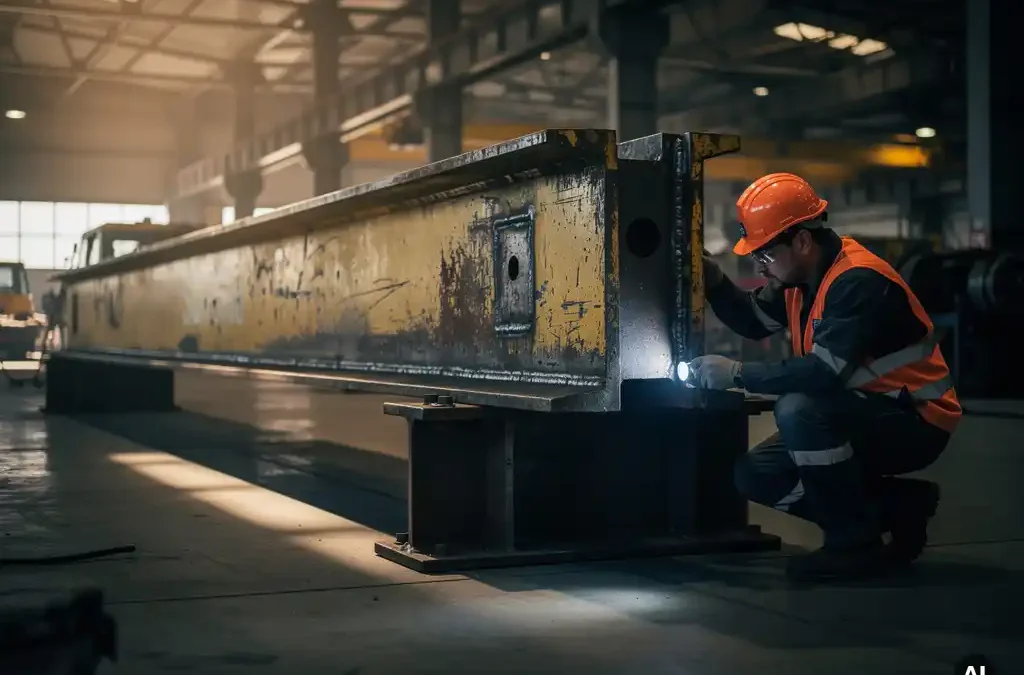
A crane boom inspection involves a systematic examination of the boom’s structural components, welds, connections, and mechanical systems to verify that the crane is safe and fit for operation. Inspections follow a defined process that combines visual checks with non-destructive testing methods, depending on the crane type, its operating environment, and its service history. The sections below answer the most common questions about what a crane boom inspection actually involves.
What parts of a crane boom are inspected?
A crane boom inspection covers every load-bearing and structurally significant element of the boom. For telescopic booms, this includes each boom section, the extension cylinders, slide pads, wear strips, and the boom head. For lattice booms, inspectors examine the chord members, lacing elements, pin connections, and bolted joints throughout the entire structure.
Beyond the steel structure itself, the inspection extends to:
- Welds and heat-affected zones along the full length of the boom
- Pin holes, pins, and securing devices at connection points
- Sheaves, hook blocks, and load lines at the boom tip
- Hydraulic hoses and cylinders integrated into telescopic sections
- Protective coatings and surface conditions that indicate corrosion or mechanical damage
Each of these areas can develop defects independently, which is why a thorough crane boom structural inspection treats the boom as a system rather than a single component.
What inspection methods are used on crane booms?
Crane boom inspections use a combination of visual inspection and non-destructive testing (NDT) methods. Visual inspection is always the starting point, but NDT techniques are applied wherever the visual check cannot confirm structural integrity with sufficient confidence.
The most commonly used methods in a crane inspection process include:
- Visual inspection: A close examination of all accessible surfaces for cracks, deformation, corrosion, and wear. Inspectors look for any deviation from the original geometry.
- Magnetic Particle Inspection (MPI): Applied to welds and high-stress areas to detect surface and near-surface cracks that are invisible to the naked eye. MPI is particularly effective on the high-grade steels used in modern crane booms.
- Ultrasonic testing (UT): Used to detect internal flaws within the steel, including subsurface cracks and inclusions that MPI cannot reach.
- X-ray testing: Employed when a third-party Notified Body is required to verify the quality of a repair or assess a weld that cannot be reached by other means.
The selection of methods depends on the crane’s age, the nature of any suspected damage, and the requirements of the applicable inspection standard or certification authority.
What defects does a crane boom inspection look for?
A crane boom inspection checklist targets defects that compromise structural integrity or safe operation. The most critical defects are cracks in welds or base material, which can propagate rapidly under load and lead to catastrophic failure if left unaddressed.
Other defects that inspectors actively look for include:
- Dents, buckles, or permanent deformation in boom sections caused by overloading or impact
- Corrosion and pitting, particularly in areas where protective coatings have broken down
- Wear on slide pads, wear strips, and pin holes that affects boom alignment or load transfer
- Cracked or missing welds at chord connections on lattice booms
- Hydraulic leaks or damaged hoses within telescopic boom sections
- Bent or deformed pins and loose or missing securing devices
Identifying these defects early is what separates a routine crane maintenance inspection from an emergency repair situation. Minor cracks found during a scheduled inspection are far less costly to address than a structural failure discovered under load.
How often should a crane boom be inspected?
The required frequency of crane boom inspections depends on the applicable regulations, the crane manufacturer’s recommendations, and the intensity of the crane’s working environment. In most jurisdictions, cranes in regular commercial use must undergo a formal inspection at least once a year, with more frequent checks required for cranes operating in harsh or high-cycle environments.
In practice, inspection frequency is shaped by several factors. Cranes working in offshore or marine environments face accelerated corrosion and fatigue, which typically justifies more frequent structural checks. Cranes that have been involved in an incident, overloaded, or returned from an unusually demanding project should be inspected before returning to service, regardless of when the last scheduled inspection took place.
Operators should also carry out pre-use checks at the start of each working day. These are not formal structural inspections, but they catch obvious damage, leaks, or mechanical issues before they become safety risks. Formal structural inspections by qualified personnel are a separate requirement and cannot be replaced by daily operator checks.
What happens after a crane boom inspection is completed?
After a crane boom inspection is completed, the inspector produces a written report documenting every finding, the methods used, and a clear assessment of the crane’s condition. This report forms the basis for any further action and is an essential record for compliance and certification purposes.
The outcome of the inspection falls into one of three categories. If no defects are found, the crane is confirmed as fit for continued operation and the inspection record is filed. If minor defects are identified that do not immediately affect safe operation, a monitoring or maintenance plan is put in place with a defined timeline for corrective action. If structural defects are found that compromise safety, the crane is taken out of service until repairs are completed and the affected areas are re-inspected and cleared.
Documentation produced after the inspection is also used to maintain CE certification validity and to satisfy the requirements of insurers, clients, and regulatory authorities. Keeping accurate inspection records is not only a legal obligation in most operating environments: it is also a practical tool for tracking the long-term condition of a crane asset.
Can a crane boom be repaired instead of replaced after inspection?
In most cases, yes, a crane boom can be repaired rather than replaced, even when significant defects are found during inspection. Repair is almost always faster and substantially less expensive than sourcing a new boom section from the original manufacturer, and when carried out correctly, the repaired boom returns to its original rated capacity.
The key condition is that the repair must be performed by specialists with the technical capability to work on the specific grade of steel used in the boom. High-performance mobile cranes increasingly use steels rated at 960 or 1100 N/mm², which require dedicated welding procedures, controlled workshop conditions, and certified welders with specific qualifications for these materials. Not every repair provider has this capability, and attempting a repair without the correct procedures can introduce new risks rather than eliminate existing ones.
When a repair is completed to the correct standard, it includes full NDT verification of all new welds, and the crane’s CE certification remains valid. A reputable repair specialist will also provide a guarantee on the work performed. You can find more detail on what this process involves on the crane boom repair service page.
How Rusch Cranes helps with crane boom inspections and repairs
Rusch Cranes brings over 30 years of specialized experience to crane boom inspections and structural repairs. For clients in the Netherlands, Rusch provides on-shore inspection services, offering rigorous assessments carried out by qualified technicians using proven NDT methods. For boom repairs, Rusch operates worldwide, deploying experienced teams internationally at short notice to carry out work wherever it is needed.
What sets Rusch apart in the repair process specifically:
- One of only three companies in Europe qualified to repair telescopic booms made from 960- and 1100-grade high-strength steel
- Every repair includes a full Welding Procedure Specification, 100% MPI on all new welds, and third-party NDT verification when required
- CE certification remains valid after repair, and all work is backed by a one-year guarantee
- Lattice boom repairs can be carried out at the client’s location anywhere in the world, or at the Rusch workshop in Medemblik, Netherlands
If your crane has recently been inspected and defects have been identified, or if you want to schedule a structural assessment, contact Rusch Cranes to discuss the most efficient path back to full operational capacity.
Related Articles
- My crane boom was damaged on site — what do I do first?
- How do repair engineers decide which parts of a collapsed multi-section boom to fix first?
- What causes the main chords on a lattice crane boom to buckle?
- What should I actually look for when comparing crane boom repair companies?
- What NDT methods are used to inspect a crane boom repair weld?
Recent Comments