
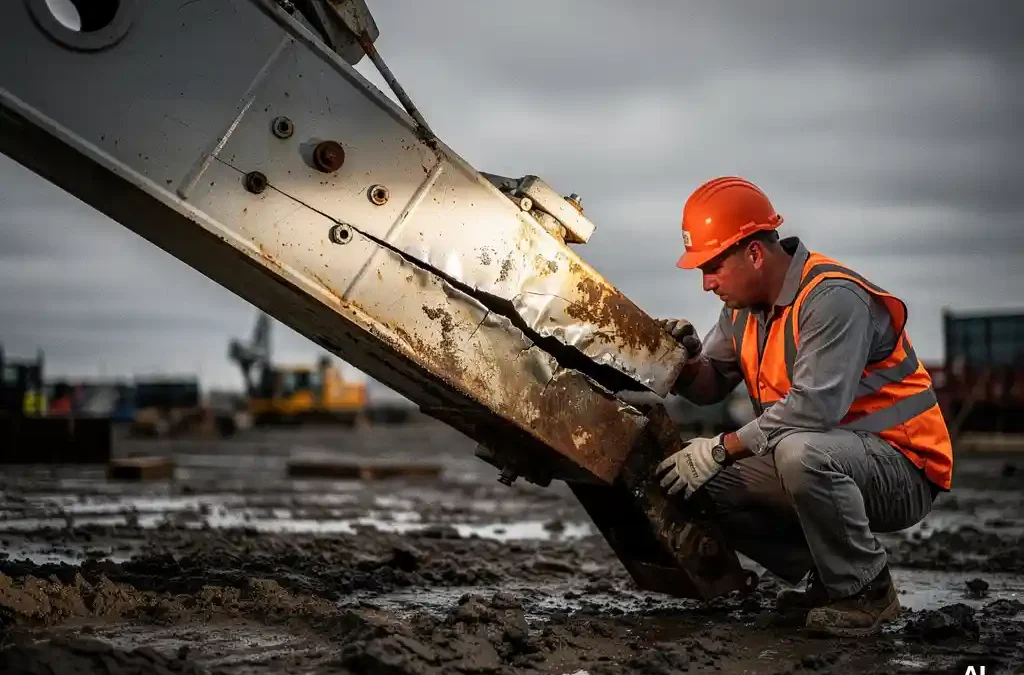
Yes, a crane boom inspection is needed after a near miss, without exception. Even when no visible damage is apparent, the forces involved in a near-miss incident can introduce structural stress, micro-cracks, or deformation that only a qualified inspection will reveal. For crane operators, fleet managers, and HSE officers, skipping that inspection is not a calculated risk; it is a liability. The sections below address the most important questions surrounding near-miss crane incidents and what they mean for your equipment.
What counts as a near miss for a crane?
A near miss for a crane is any unplanned event involving the crane or its load that had the potential to cause injury, structural failure, or property damage but did not result in harm. This includes sudden load drops, boom contact with structures or power lines, overloading events, unexpected ground settlement under outriggers, and loss of load control during lifts.
Near misses are not limited to dramatic incidents. A boom that brushes against a building, a hook block that swings and strikes the crane body, or a telescopic section that retracts unexpectedly under load all qualify. The defining characteristic is not the outcome but the potential: if the sequence of events had been slightly different, a serious accident could have occurred.
In practice, near misses are frequently under-reported because no injury occurred and the crane appears undamaged. This is a dangerous assumption. The absence of visible damage does not mean the crane is structurally sound.
Does a near miss legally require a crane inspection?
In most jurisdictions, a near miss that involves a crane must be reported and documented, and in many cases triggers a mandatory inspection before the crane returns to service. In the Netherlands, for example, workplace safety legislation under the Arbeidsomstandighedenwet (Working Conditions Act) requires employers to investigate incidents and near misses, and regulators expect equipment involved in such events to be assessed before continued use.
Beyond national legislation, crane operators working under standards such as EN 13000 or those bound by client HSE requirements will typically find that their contracts and safety management systems mandate an inspection following any incident (near miss or otherwise). Offshore operators on the continental shelf face particularly strict compliance frameworks, where any unplanned load event triggers a formal review process.
Even where no specific regulation explicitly mandates a post-near-miss inspection, the duty of care owed to operators and site personnel effectively requires one. If a crane that was involved in a near miss causes a subsequent accident, the absence of a post-incident inspection will significantly increase legal and financial exposure.
What damage can a near miss cause to a crane boom?
A near miss can cause a range of structural damage to a crane boom, much of it invisible to the naked eye. The most serious concern is the introduction of stress fractures or micro-cracks in the high-grade steel, particularly in welds and high-tension zones. These defects do not prevent the crane from operating immediately, but they propagate under continued load and can lead to catastrophic failure.
Common forms of boom damage following a near miss include:
- Micro-cracks in welds: caused by sudden shock loading or impact, often undetectable without magnetic particle inspection (MPI) or ultrasonic testing
- Deformation of boom sections: telescopic sections can bend or distort under unexpected lateral forces, affecting extension and retraction
- Buckling of boom chords or lacing: particularly relevant for lattice booms subjected to overload or side-loading
- Damage to wear pads and slide elements: contact between boom sections during an uncontrolled event can accelerate wear or cause misalignment
- Compromised corrosion protection: impact or abrasion can breach surface coatings, accelerating corrosion in high-stress areas
Modern mobile crane booms are manufactured from very high-grade steel, up to 960 or 1100 N/mm², which offers exceptional strength but requires specialist knowledge to inspect and repair correctly. Damage to these materials behaves differently from lower-grade structural steel, which is why standard welders and generalist inspection services are not equipped to assess them.
How is a post-incident crane boom inspection carried out?
A post-incident crane boom inspection follows a structured process that moves from visual assessment through to non-destructive testing (NDT), with the scope determined by the nature of the incident and the type of boom. The inspection must be carried out by qualified personnel with specific experience in high-grade crane steel.
The process typically unfolds in the following order:
- Initial visual inspection: the entire boom is examined for visible deformation, cracks, coating damage, and misalignment of sections
- Dimensional checks: measurements are taken to detect any bending, twisting, or change in profile compared to manufacturer specifications
- Magnetic Particle Inspection (MPI): applied to welds and high-stress zones to detect surface and near-surface cracks that are invisible to the eye
- Ultrasonic testing (UT): used where internal defects are suspected, providing a view of the material’s internal integrity
- X-ray testing: applied in cases where deeper internal examination of welds or material is required
- Documentation and reporting: all findings are recorded, photographs are taken, and a formal report is produced to support compliance and insurance requirements
For telescopic booms made from 960 or 1100 grade steel, this inspection requires highly specialized expertise. The material properties of ultra-high-strength steel mean that standard NDT interpretation does not apply directly, and incorrect assessment can lead to either premature decommissioning or, more dangerously, a false clearance.
Can a crane boom be repaired if damage is found after a near miss?
Yes, in many cases a crane boom can be repaired to full operational value after a near miss, including booms made from high-grade steels up to 1100 N/mm². Whether repair is viable depends on the type and extent of the damage, the grade of steel involved, and whether the repair can be carried out under certified conditions that preserve CE compliance.
Repair is often the most practical and cost-effective path. Sourcing replacement boom sections from OEM manufacturers involves long lead times and very high costs. A qualified crane boom repair carried out to the correct standard restores the boom to a value equal to the original, with CE testing remaining valid after the repair is completed.
Not every repair specialist is equipped to work on ultra-high-strength crane steel. Welding on 960 or 1100 grade material requires a Welding Procedure Specification (WPS) developed specifically for that steel grade, precise preheat and interpass temperature control, and post-weld inspection using MPI and, where required, ultrasonic or X-ray testing. Repairs performed outside these conditions risk introducing new failure points rather than eliminating existing ones.
When should a crane be taken out of service after a near miss?
A crane should be taken out of service immediately after a near miss and must not return to operation until a qualified inspection has been completed and the crane has been formally cleared. This applies regardless of whether damage is visible. Operating a crane that has been involved in an incident without inspection puts operators, site personnel, and third parties at risk.
Specific circumstances that require immediate decommissioning pending inspection include any event involving overloading beyond the rated capacity, boom contact with a fixed structure or power line, sudden loss of load, ground failure under outriggers, and any incident where the crane’s stability was compromised. In these cases, the structural integrity of the boom and the crane’s primary load-bearing components cannot be assumed without testing.
For fleet managers and operations teams, the decision to take a crane out of service is rarely straightforward: downtime has a direct cost. However, the cost of a thorough inspection and any required repair is consistently lower than the financial, legal, and human consequences of a structural failure during a subsequent lift. Restoring the crane to service with a documented inspection record also protects the operator’s compliance position and preserves the validity of the crane’s CE certification.
How Rusch Cranes helps after a crane near miss
Rusch Cranes provides specialist support for crane owners and operators dealing with the aftermath of a near-miss incident. With over 27 years of experience in high-grade crane steel repair, Rusch offers a complete post-incident response:
- Specialist boom inspection: including full visual assessment, MPI, and ultrasonic or X-ray testing where required, carried out in the Netherlands
- Repair of telescopic and lattice booms: including ultra-high-strength steels up to 1100 N/mm², restoring the boom to original operational value
- CE compliance preserved: all repairs are completed under certified conditions, with CE testing remaining valid after completion
- 1-year guarantee on all repairs performed
- Global deployment: Rusch Worldwide Welding can mobilize repair technicians to any location worldwide, handling all logistics including visas and customs
If your crane has been involved in a near miss, do not wait. Contact Rusch Cranes to arrange an inspection or discuss your repair requirements with a specialist.
Related Articles
- What is the difference between a proof load test and a rated load test for a repaired crane boom?
- What is hydrogen cracking and can it affect a repaired crane boom weld?
- What happens to a crane boom when it takes a side load it was not designed for?
- When does rust pitting on a crane boom shell need a patch versus a full insert replacement?
- How do repair costs differ between on-site repair and workshop repair?
Recent Comments