
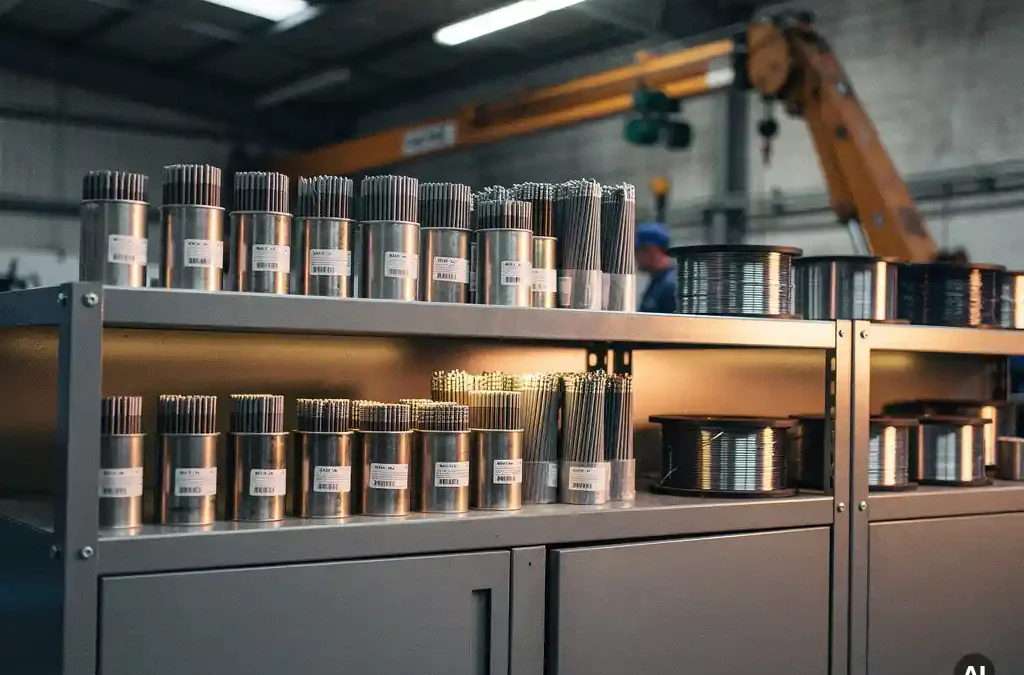
Welding consumables for crane boom repair should be stored in dry, temperature-controlled conditions, away from moisture, contamination, and mechanical damage. Electrodes and filler wires must be kept in sealed, manufacturer-approved packaging until use, while shielding gases require secure, upright storage in ventilated areas. Correct storage is not optional: it directly determines whether a weld on high-grade steel will meet the strength and integrity demands of a working crane boom.
This matters especially for crane booms manufactured from high-strength steel grades such as 960 and 1100 N/mm², where the margin for weld defects is extremely narrow. Poor consumable storage is one of the most common and preventable causes of weld failure in crane boom repair. The sections below cover every stage of consumable storage and handling, from the moment materials arrive at your facility to the point they reach the weld site.
What types of consumables are used in crane boom welding?
Crane boom welding uses a range of consumables matched to the base material grade and the welding process applied. The most common types are coated electrodes (for manual metal arc welding), solid and metal-cored filler wires (for MIG/MAG processes), flux-cored wires, submerged arc welding flux, and shielding gases such as argon, helium, or mixed gas blends.
Because crane booms are increasingly manufactured from very high-strength steels, the consumables used must be specifically approved for those grades. A filler wire rated for standard structural steel cannot be substituted on a 960 or 1100 grade boom without compromising the weld’s mechanical properties. Each consumable type also comes with its own classification system, AWS or EN standards, for example, which defines its chemical composition, strength rating, and the conditions under which it must be stored and used.
Beyond the welding materials themselves, consumables in this context also include anti-spatter compounds, cleaning agents, and preheat materials. While these are secondary, they still require appropriate storage to remain effective and safe.
Why does improper consumable storage affect weld quality on crane boom repairs?
Improper storage of welding consumables degrades their chemical and physical properties, leading directly to weld defects such as porosity, hydrogen cracking, and incomplete fusion. On crane booms, which carry dynamic loads and operate under high stress, any weld defect can become a critical failure point that puts equipment and personnel at risk.
The most serious risk associated with poor storage is hydrogen-induced cracking, also called cold cracking. Moisture absorbed by low-hydrogen electrodes or flux releases hydrogen into the weld pool during the welding process. In high-strength steels, the tolerance threshold for hydrogen is extremely low: even small concentrations can cause delayed cracking that may not appear until hours or days after the weld is completed.
Beyond hydrogen cracking, contaminated or damaged consumables can introduce inclusions, produce inconsistent arc behavior, and cause poor bead geometry. All of these outcomes make it harder or impossible to pass the post-weld inspection requirements that apply to crane boom repair, including visual inspection, magnetic particle inspection, and ultrasonic or X-ray testing where required.
How should welding electrodes and filler wires be stored?
Welding electrodes and filler wires should be stored in their original sealed packaging in a dry, climate-controlled environment at temperatures between 15°C and 25°C, with relative humidity kept below 60%. Low-hydrogen electrodes require the strictest conditions and must be rebaked in a rod oven before use if they have been exposed to ambient air for more than the manufacturer’s specified time limit.
The following practices form the baseline for correct electrode and filler wire storage:
- Keep all electrodes in sealed, manufacturer-approved containers until immediately before use
- Store low-hydrogen electrodes in a heated cabinet or rod oven set to the manufacturer’s specified holding temperature, typically between 100°C and 150°C
- Never store electrodes directly on the floor; use shelving that allows air circulation and prevents contact with moisture from concrete
- Label all opened packages with the date of opening and track exposure time against manufacturer limits
- Store filler wire spools in sealed bags with desiccant packets, away from direct sunlight and temperature fluctuations
- Inspect wire spools for surface oxidation or corrosion before use; discolored or rusty wire must be discarded
For high-grade steel welding consumables specifically approved for 960 or 1100 grade booms, rebaking procedures are often mandatory after any exposure to ambient conditions. Always follow the Welding Procedure Specification (WPS) for the specific repair, as it will define the exact storage and conditioning requirements for the approved consumables.
What are the correct storage conditions for shielding gases and flux?
Shielding gas cylinders must be stored upright, secured against falling, in a well-ventilated area away from heat sources, open flames, and direct sunlight. Welding flux must be stored in sealed, dry containers at a stable temperature, and, like low-hydrogen electrodes, it must be dried or rebaked if it has absorbed moisture before use.
Shielding gas purity is critical for high-strength steel welding. Even small amounts of contamination from moisture or oxygen in the gas supply can cause porosity in the weld. Cylinder valves should always be capped when not in use, and regulators should be inspected regularly for leaks or damage. Mixed gas cylinders (such as argon-CO2 blends) should be stored separately from pure oxygen cylinders in accordance with applicable safety regulations.
For submerged arc welding flux, the storage requirements are comparable to those for low-hydrogen electrodes. Flux that has been opened or exposed to humidity must be dried at temperatures specified by the manufacturer before it is returned to service. Unused flux reclaimed from the welding area should never be mixed back with fresh, sealed flux, as it may carry contamination that affects weld chemistry.
How should consumables be handled when moving from storage to the weld site?
When moving welding consumables from storage to the weld site, they should be transported in protective, sealed containers and only removed immediately before use. Electrodes and filler wires should be kept in heated quivers or portable rod ovens during transport to the weld area, particularly on outdoor sites or offshore platforms where humidity and temperature vary significantly.
Follow these steps when transferring consumables from storage to the point of use:
- Check the storage log to confirm the consumable has not exceeded its exposure time limit
- Transfer electrodes directly from the heated cabinet into a portable heated quiver set to the manufacturer’s holding temperature
- Carry only the quantity needed for the immediate welding session; do not draw excess stock that will be returned to storage
- Inspect each electrode or wire spool visually before use, checking for coating damage, moisture, rust, or contamination
- On outdoor or offshore sites, shield the weld area from wind, rain, and direct exposure to salt air before beginning work
- Document the batch number and condition of consumables used as part of the repair record
This documentation step is particularly important for certified crane boom repairs, where traceability of materials forms part of the quality record reviewed during inspection and certification.
What storage standards and certifications apply to welding consumables for crane repair?
Welding consumables used in crane boom repair must comply with EN ISO 2560 (for covered electrodes), EN ISO 14341 (for MIG/MAG solid wires), and equivalent standards depending on the process. Storage and handling requirements are also governed by the manufacturer’s data sheets, the applicable Welding Procedure Specification, and any quality management framework such as ISO 9001 under which the repair is carried out.
For crane boom repairs specifically, the relevant standards are not limited to the consumables themselves. The entire repair process (including material traceability, storage conditions, and welder qualification) must align with the requirements of the applicable machinery directive and any notified body overseeing CE certification. If a repair is conducted under a certified WPS, the storage conditions specified in that procedure are binding, not advisory.
In practice, this means that a repair facility operating under ISO 9001 will maintain documented procedures for consumable receipt, storage, issue, and disposal. These records form part of the audit trail that supports the validity of the CE marking after repair. Any deviation from specified storage conditions must be recorded and assessed before the consumable is used.
How Rusch Cranes approaches consumable storage in crane boom repair
Rusch Cranes integrates strict consumable storage and handling protocols into every crane boom repair as part of a structured, certification-backed repair process. Key elements of this approach include:
- Pre-repair verification of all materials and consumables against the approved Welding Procedure Specification
- Controlled workshop conditions at the Medemblik facility designed to meet the storage requirements for high-grade steel welding consumables
- Full documentation of consumable batch numbers, storage logs, and handling records as part of the repair dossier
- Post-repair inspection including 100% visual and magnetic particle inspection on all new welds, with third-party ultrasonic or X-ray testing available when required
- A one-year guarantee on all completed repairs, with CE testing remaining valid after repair
Rusch is one of only three companies in Europe capable of repairing telescopic booms on 960 and 1100 grade mobile cranes. Whether the repair takes place at the Medemblik workshop or on-site at a client location anywhere in the world, the same material standards and storage protocols apply. To discuss a boom repair or get expert advice on your crane maintenance needs, contact the Rusch team directly.
Related Articles
- What does a crane boom inspection include?
- Why is damage near the base of a crane boom more serious than damage at the tip?
- What are the hidden costs when a crane boom fails unexpectedly on a live project?
- What are the most common failure points on a telescopic crane boom?
- What is the ROI of preventive boom inspections vs emergency repairs?
Recent Comments