
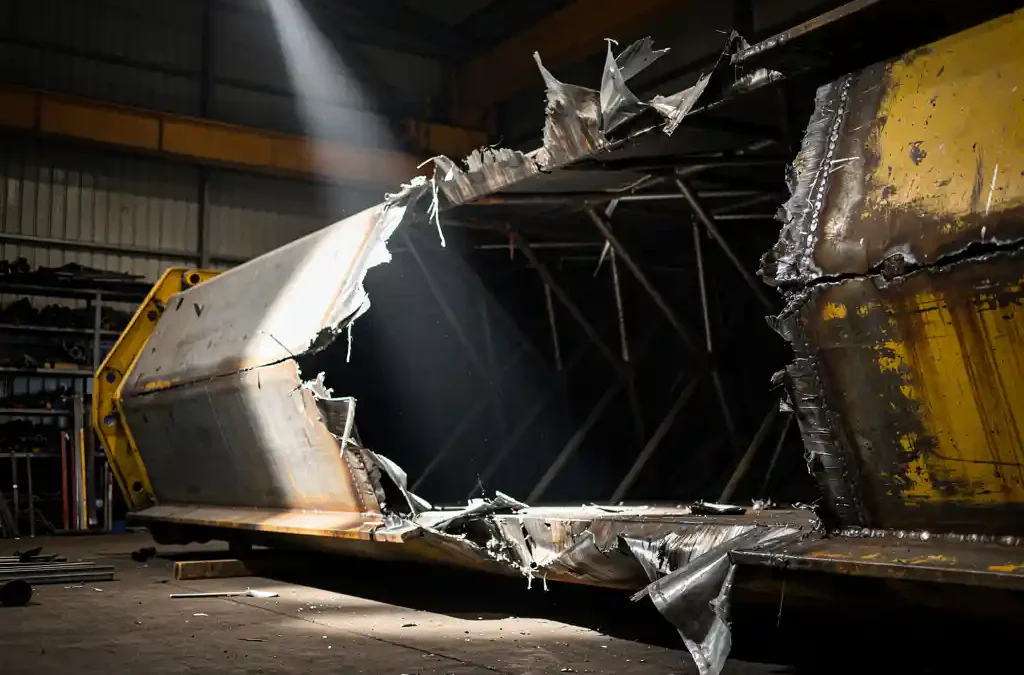
A crane boom looks solid from the outside. Thick steel, precision engineering, built to lift hundreds of tonnes. But under load, something very different is happening inside that structure — a constant battle between competing forces that the steel has to win, every single time. When it doesn’t, the consequences range from expensive to catastrophic. Understanding what actually happens inside a crane boom during failure isn’t just interesting engineering — it’s the kind of knowledge that helps operators, fleet managers, and HSE officers make better decisions before something goes wrong.
Crane boom failure rarely happens without warning. The signs are there, if you know what to look for. And the mechanics of how a boom progresses from stressed to structurally compromised follow a pattern that’s worth understanding in detail.
The structural forces at work inside a loaded boom
When a crane lifts a load, the boom doesn’t simply push upward against it. The entire structure becomes a system under multiple simultaneous stresses. The top chord of the boom is placed in compression — the steel is being squeezed together. The bottom chord is in tension — being pulled apart. The web members between them carry shear forces, transferring load along the length of the boom toward the slew ring and the rest of the crane’s structure.
In a telescopic boom, the situation is more complex. Each section slides inside the next, and the interface points between sections create concentrated stress zones. The further the boom is extended, the longer the lever arm, and the greater the bending moment acting at every point along its length. At full extension with a heavy load, the forces at the base of the outer section can be enormous — far beyond what the numbers on a load chart might intuitively suggest.
High-grade steel booms — those manufactured from steel up to 1100 N/mm² yield strength — are designed to handle these forces within tight tolerances. That strength comes with a trade-off: the material is less forgiving of defects, notches, or weld imperfections than lower-grade steel. When something is slightly wrong, the consequences escalate faster.
How failure actually progresses from micro to catastrophic
Structural failure in a crane boom almost never happens all at once. It begins at the microscopic level, with tiny cracks forming at points of stress concentration. These are often invisible to the naked eye and can exist for months or even years before they become a problem.
The progression typically follows this path:
- Crack initiation — A micro-crack forms at a stress riser, often at a weld toe, a surface scratch, a corrosion pit, or a geometric discontinuity in the steel.
- Crack propagation — Each load cycle opens the crack slightly further. This is fatigue failure in action. The crack grows slowly, often following the grain structure of the steel.
- Critical crack length — Once the crack reaches a critical size, the remaining cross-section can no longer carry the applied load. At this point, failure becomes unstable.
- Fracture — The remaining material fails rapidly, often suddenly. What looked like a small surface crack becomes a full structural collapse.
This is why a boom that has been operating without visible problems can appear to fail without warning. The warning was there — it was just happening at a scale that standard visual inspection can’t detect.
Common trigger points and where booms are most vulnerable
Not all parts of a boom are equally at risk. Certain locations concentrate stress in ways that make them significantly more likely to be the origin point of a failure.
The most vulnerable zones tend to be:
- Weld toes and heat-affected zones — Welding changes the microstructure of high-grade steel. The area immediately around a weld is often harder, more brittle, and contains residual stress from the welding process itself.
- Section transition points — In telescopic booms, the areas where one section slides into the next create contact stresses and fretting wear that can initiate cracks over time.
- Pin hole bores and attachment points — Holes for pins and bolts create stress concentrations. Any slight misalignment or wear in these areas amplifies the local stress considerably.
- Areas affected by prior impact or overload — Even a single overload event or collision with an obstacle can plastically deform the steel in ways that accelerate future fatigue.
- Corrosion sites — Surface corrosion creates pitting, and pits act as stress risers. In offshore environments especially, this is a significant and ongoing concern.
Understanding these trigger points matters because it tells you where to focus attention during inspection — and where damage found after an incident is most likely to have originated.
What visual and non-visual signs precede a boom failure
Some warning signs are visible to an experienced eye. Others require specialist equipment to detect. Both matter equally, because relying only on what you can see is how small problems become large ones.
On the visual side, look for surface cracks or paint cracking along weld seams, deformation or bowing in boom sections that wasn’t there before, unusual wear patterns at sliding surfaces, and any signs of corrosion that are more than superficial. A boom that has been overloaded may show permanent set — a slight bend or curve that doesn’t spring back. That’s a structural alarm signal.
Non-visual signs are often more significant. Magnetic Particle Inspection (MPI) reveals surface and near-surface cracks that are completely invisible to the eye. Ultrasonic testing can detect internal flaws, including cracks propagating through the wall thickness of a section. X-ray testing provides a cross-sectional view of weld quality and internal structure. None of these tests can be replaced by a careful visual inspection alone — and for high-grade steel booms, skipping them is a serious risk.
Operational signs also matter. Unusual sounds under load, changes in how the boom responds to controls, or any incident involving contact with an obstacle or an overload event should all trigger an immediate specialist inspection, not just a visual check.
Why high-grade steel booms demand specialist repair after damage
Once a crane boom has been damaged — whether through fatigue cracking, impact, overload, or corrosion — the repair process is not straightforward. This is particularly true for booms manufactured from 960 or 1100 grade steel, which require welding procedures that are genuinely rare in the industry.
Standard welding techniques used on mild steel will not work on high-strength steel. The heat input, the filler materials, the pre-heat and post-heat requirements, and the cooling rates all have to be precisely controlled. Get any of these wrong, and the repair itself becomes a new failure point — often weaker than the original damage. A Welding Procedure Specification (WPS) for this grade of steel isn’t something a general workshop can produce. It requires both specialist knowledge and validated procedures.
Beyond the welding itself, a proper crane boom repair involves thorough preparation: measuring the boom, assessing material strength, identifying all damage including non-visible defects, and photographing every repair point. After completion, 100% MPI on all new welds is the minimum standard. For critical repairs, third-party ultrasonic or X-ray testing confirms the result. This level of process is what ensures the repaired boom returns to its original structural value — not just looks acceptable on the surface.
The CE certification of the crane also depends on repair quality. A repair carried out without the right procedures and documentation can invalidate the crane’s certification, creating compliance and liability problems that go well beyond the cost of the repair itself.
How Rusch Cranes helps after crane boom damage
When a crane boom has been damaged, the path back to full operation requires more than welding. It requires the kind of specialist knowledge that’s genuinely rare in Europe.
We are one of only three companies in Europe qualified to repair telescopic booms made from 960 and 1100 grade high-strength steel. Our approach covers the full process from initial assessment to certified completion:
- Full damage assessment including MPI and, where needed, ultrasonic or X-ray testing
- Preparation of a Welding Procedure Specification and Repair Plan before any work begins
- Repair of both telescopic and lattice booms, in our workshop in Medemblik or on-site anywhere in the world
- 100% MPI on all new welds upon completion, with third-party Notified Body inspection where required
- Full CE certification validity maintained after repair, with a 1-year guarantee on all work performed
If a crane boom has been damaged or you want a specialist assessment before a problem develops further, get in touch with our team to discuss what’s needed.
Frequently Asked Questions
How often should a crane boom be inspected for fatigue cracks, and what type of inspection is sufficient?
Inspection frequency depends on the crane’s operational intensity, age, and working environment, but high-grade steel booms should undergo MPI at least annually as a minimum — more frequently for cranes in offshore, high-cycle, or corrosive environments. Visual inspection alone is not sufficient for detecting the micro-cracks that precede structural failure. A combination of visual checks before each shift and scheduled non-destructive testing (MPI, ultrasonic, or X-ray) by a qualified specialist gives you the most complete picture of boom condition.
Can a crane boom be safely returned to service after an overload event if it looks undamaged?
No — a visual inspection after an overload event is not enough to confirm the boom is safe. A single overload can plastically deform the steel and introduce internal stresses or micro-cracks that are invisible to the eye but dramatically accelerate future fatigue failure. Any overload event should be treated as a trigger for immediate specialist inspection, including MPI and potentially ultrasonic testing, before the crane returns to service.
What's the difference between repairing a standard steel boom and a 960 or 1100 grade high-strength steel boom?
The difference is significant. High-strength steel grades like 960 and 1100 N/mm² require strictly controlled welding procedures — specific filler materials, precise pre-heat and post-heat temperatures, and controlled cooling rates — that are entirely different from those used on mild or standard structural steel. Applying standard welding techniques to high-grade steel can create a repair zone that is harder, more brittle, and weaker than the surrounding material, effectively making the repair a new failure point. This is why only a small number of specialist companies in Europe are qualified to carry out these repairs correctly.
How do I know if a crack found during inspection is a surface defect or a deeper structural problem?
Surface appearance alone cannot tell you how deep a crack extends into the material. MPI will reveal surface and near-surface cracks, but ultrasonic testing is needed to determine whether a crack has propagated through the wall thickness of a boom section. For any crack found at a high-stress location — such as a weld toe, pin hole bore, or section transition point — assume it requires specialist evaluation rather than a judgement call on-site. The critical crack length threshold can be reached quickly once propagation is underway.
Does having a crane boom repaired affect the crane's CE certification?
Yes, it can — and this is one of the most commonly overlooked risks of substandard repair work. A repair carried out without a validated Welding Procedure Specification, proper documentation, and post-repair inspection by a qualified party can invalidate the crane’s CE certification. This creates serious compliance and liability exposure, particularly if the crane is subsequently involved in an incident. Ensuring your repair provider can deliver full documentation and, where required, third-party Notified Body sign-off is essential to maintaining certification validity.
What should I do immediately after a crane boom makes contact with an obstacle or structure during operation?
Take the crane out of service immediately and do not attempt to assess structural integrity through visual inspection alone. Even a low-energy impact can introduce localised plastic deformation or initiate cracks at existing stress risers, particularly in high-grade steel booms where the material is less forgiving of sudden loading events. Document the incident, photograph the affected area, and arrange a specialist inspection — including MPI of the impact zone and surrounding welds — before the crane returns to work.
Are lattice booms subject to the same failure mechanics as telescopic booms, or are they a different risk profile?
The fundamental failure mechanics — crack initiation at stress risers, fatigue propagation under cyclic loading, and rapid fracture once critical crack length is reached — apply to both boom types. However, the vulnerable locations differ. Lattice booms concentrate risk at chord-to-lacework weld connections, pin joints, and any sections that have experienced bending or torsional loading outside their design envelope. Telescopic booms have the additional complexity of section interface points and sliding contact wear. Both types require specialist inspection and, when damaged, specialist repair using appropriate welding procedures for the steel grade involved.
Related Articles
- How do welders plan which areas of a crane boom to repair first?
- Why do crane operators often not report boom damage — and what can go wrong?
- Is it always more expensive to delay a crane boom repair than to do it straight away?
- What is a Welding Procedure Specification and why does it matter for boom repair?
- Is it cheaper to repair a lattice boom or replace it?
Recent Comments